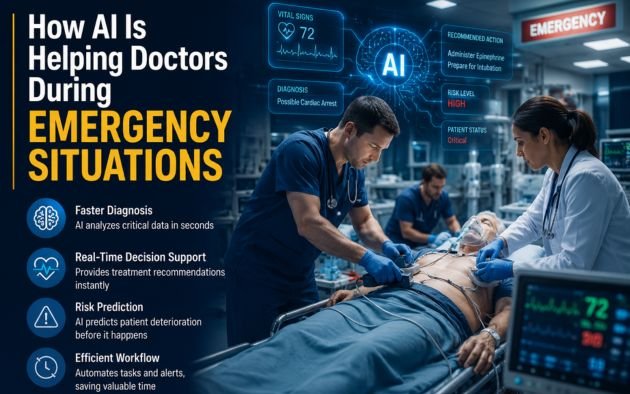
Artificial Intelligence (AI) is becoming one of the most important technologies in modern emergency healthcare. In critical medical situations where every second matters, AI is helping doctors make faster decisions, improve diagnosis accuracy, and save lives.
Emergency departments around the world often face major challenges such as overcrowding, limited staff, delayed diagnosis, and increasing patient emergencies. Doctors and healthcare professionals must quickly analyze symptoms, monitor patients, and decide the best treatment options under intense pressure.
AI-powered healthcare systems are now helping medical teams respond more efficiently during emergencies by analyzing large amounts of patient data in real time. From detecting strokes and heart attacks to monitoring ICU patients and improving ambulance response systems, AI is transforming emergency medicine faster than ever before.
In this article, we will explore how AI helps doctors during emergencies, its real-world applications, benefits, risks, and the future of AI-powered emergency healthcare.
What Is AI in Emergency Healthcare?
Artificial Intelligence in emergency healthcare refers to advanced computer systems that can analyze medical information, identify patterns, and support healthcare professionals during urgent medical situations.
AI technologies commonly used in emergency care include:
- Machine Learning
- Predictive Analytics
- Computer Vision
- Natural Language Processing
- Real-Time Monitoring Systems
These technologies help doctors:
- Detect medical emergencies faster
- Monitor critical patients
- Predict complications
- Improve treatment decisions
- Reduce response time
AI does not replace doctors during emergencies. Instead, it acts as a support system that helps medical professionals make quicker and more informed decisions.
➡ Related Guide:
Artificial Intelligence in Healthcare: Complete Guide to AI Applications, Benefits, Risks & Future
Why AI Is Becoming Important in Emergency Situations?
Emergency medicine requires speed, accuracy, and constant patient monitoring. Delays or errors during critical situations can become life-threatening.
Hospitals often face:
- Overcrowded emergency rooms
- High patient loads
- Limited healthcare staff
- Increasing medical complexity
AI helps healthcare providers manage these challenges more effectively.
AI is becoming important because it can:
- Analyze patient data quickly
- Identify hidden warning signs
- Monitor patients continuously
- Predict medical deterioration
- Support emergency decision-making
This helps doctors respond faster during life-threatening situations.
How AI Helps Doctors During Emergency Situations?
AI is already being used in several areas of emergency healthcare.
1. Early Detection of Heart Attacks
Heart attacks require immediate medical attention. AI systems can analyze:
- ECG readings
- Heart rate patterns
- Patient history
- Vital signs
to identify early signs of cardiac emergencies.
AI-powered monitoring systems can alert doctors before a patient’s condition becomes critical.
Early intervention improves survival chances and reduces complications.
2. Faster Stroke Detection
Stroke treatment becomes more effective when diagnosed quickly.
AI-powered imaging systems can analyze brain scans within minutes and identify:
- Brain bleeding
- Blocked blood vessels
- Stroke severity
This allows doctors to begin emergency treatment faster.
In many hospitals, AI is helping reduce stroke diagnosis time significantly.
3. Real-Time ICU Patient Monitoring
Patients in Intensive Care Units (ICUs) require constant monitoring.
AI systems can track:
- Blood pressure
- Oxygen levels
- Heart rate
- Breathing patterns
- Temperature changes
AI continuously analyzes this data and alerts healthcare teams if it detects signs of medical deterioration.
This helps doctors respond quickly before conditions become severe.
4. Predicting Medical Emergencies Before They Happen
One of the most powerful applications of AI is predictive analytics.
AI systems can analyze patient data and identify risks before visible symptoms appear.
AI may help predict:
- Sepsis
- Cardiac arrest
- Respiratory failure
- Organ complications
Predictive AI gives doctors valuable time to begin preventive treatment early.
5. AI in Ambulance and Emergency Response Systems
AI is also improving ambulance operations and emergency response coordination.
AI-powered systems help:
- Optimize ambulance routes
- Predict traffic conditions
- Prioritize emergency calls
- Share patient data with hospitals in advance
Some emergency systems allow paramedics to transmit patient information directly to hospitals before arrival.
This helps emergency teams prepare treatment earlier.
6. Emergency Room Patient Prioritization
Emergency departments often receive multiple patients simultaneously.
AI helps hospitals prioritize patients based on:
- Severity of condition
- Symptoms
- Vital signs
- Risk factors
This process is known as triage.
AI-assisted triage systems help hospitals treat critically ill patients more quickly and efficiently.
7. AI-Powered Medical Imaging During Emergencies
Medical imaging is critical during trauma and emergencies.
AI-powered imaging systems help doctors analyze:
- CT scans
- X-rays
- MRI scans
more quickly and accurately.
AI can assist in detecting:
- Internal bleeding
- Fractures
- Brain injuries
- Lung damage
Fast imaging analysis can improve emergency treatment decisions.
➡ Related Article:
Top 10 Real-World Applications of AI in Healthcare
8. AI Support for Emergency Doctors
Emergency physicians work under high stress and must make rapid decisions.
AI-powered support systems can:
- Provide treatment recommendations
- Analyze patient records
- Suggest possible diagnoses
- Identify medication risks
These systems help doctors access critical information quickly during emergencies.
However, final medical decisions still depend on human healthcare professionals.
9. AI in Telemedicine and Remote Emergency Care
AI is also improving remote emergency healthcare services.
Patients in rural or remote areas can receive faster medical guidance through:
- AI symptom checkers
- Telemedicine platforms
- Remote patient monitoring systems
AI-powered telehealth systems help connect patients with emergency medical support more efficiently.
10. Reducing Human Errors During Emergencies
Emergency medicine involves high-pressure environments where mistakes can happen.
AI helps reduce risks by:
- Monitoring patient data continuously
- Detecting abnormalities
- Providing alerts
- Supporting decision-making
AI can improve accuracy and reduce diagnostic errors during critical situations.
Benefits of AI in Emergency Healthcare
AI offers several major advantages for emergency medicine.
Faster Diagnosis
AI systems process medical data rapidly, helping doctors identify emergencies sooner.
Improved Patient Monitoring
Continuous monitoring helps detect sudden health changes before complications worsen.
Better Emergency Response
AI improves coordination between ambulances, emergency departments, and healthcare teams.
Reduced Medical Errors
AI helps doctors identify hidden risks and supports more accurate decision-making.
Improved Patient Outcomes
Earlier detection and faster treatment can significantly improve survival rates.
Challenges and Risks of AI in Emergency Medicine
Although AI offers many benefits, there are also important challenges.
Data Privacy and Security
Emergency healthcare systems handle sensitive patient information.
Protecting medical data from cyber threats is essential.
AI Accuracy Limitations
AI systems are not always perfect and may sometimes generate inaccurate predictions.
Doctors must verify AI-generated recommendations carefully.
Dependence on Technology
Healthcare professionals should avoid over-reliance on AI systems during emergencies.
Human judgment remains extremely important.
High Implementation Costs
Advanced AI systems can be expensive for smaller hospitals and healthcare centers.
Ethical Concerns
Questions remain regarding:
- Responsibility for AI errors
- Medical accountability
- AI transparency
Healthcare organizations must implement AI responsibly.
Future of AI in Emergency Healthcare
The future of AI in emergency medicine looks highly promising.
Future technologies may include:
- Smart emergency rooms
- AI-powered ambulances
- Real-time predictive monitoring
- Robotic emergency support
- Wearable emergency alert devices
Hospitals may increasingly use AI to improve emergency response speed and patient care efficiency.
➡ Related Article:
Future of AI in Healthcare: What Will Hospitals Look Like in 2030?
Can AI Replace Emergency Doctors?
AI is highly effective at analyzing data and identifying patterns quickly, but emergency medicine also requires:
- Human experience
- Emotional understanding
- Critical thinking
- Ethical judgment
Doctors provide reassurance, communication, and life-saving decisions that AI cannot fully replace.
AI works best as a supportive tool that enhances emergency healthcare rather than replacing medical professionals.
➡ Related Article:
AI vs Human Doctors: Who Makes Better Medical Decisions?
Final Thoughts
Artificial Intelligence is transforming emergency healthcare by helping doctors detect medical emergencies faster, monitor patients more effectively, and improve treatment decisions during critical situations.
From stroke detection and ICU monitoring to AI-powered ambulance systems and predictive analytics, AI is improving emergency medicine in ways that can save lives and reduce complications.
However, responsible implementation remains essential. Healthcare providers must balance AI innovation with patient safety, privacy protection, and human medical expertise.
The future of emergency healthcare will likely involve strong collaboration between AI technologies and healthcare professionals working together to provide faster, smarter, and more effective emergency care.