Artificial Intelligence (AI) is rapidly transforming the healthcare industry. From disease diagnosis and medical imaging to predictive analytics and robotic surgery, AI is becoming an important part of modern medicine. As healthcare technologies continue evolving, one question is gaining global attention:
Can AI make better medical decisions than human doctors?
Some people believe AI may eventually replace doctors because of its ability to process huge amounts of medical data quickly and accurately. Others argue that healthcare requires human empathy, emotional understanding, ethical considerations, and clinical experience that machines cannot fully replicate.
The reality is more complex. AI is highly powerful in many medical tasks, but human doctors still play a critical role in patient care and decision-making.
In this article, we will explore the differences between AI and human doctors, compare their strengths and limitations, analyze how AI supports healthcare professionals, and discuss the future of medical decision-making in an AI-powered world.
Understanding AI in Healthcare
Artificial Intelligence in healthcare refers to advanced computer systems that can analyze medical data, identify patterns, and support healthcare professionals during diagnosis, treatment, and patient care.
AI technologies used in healthcare include:
- Machine Learning
- Deep Learning
- Computer Vision
- Predictive Analytics
- Natural Language Processing
- Generative AI
These systems can analyze:
- Medical images
- Patient records
- Laboratory reports
- Disease patterns
- Clinical research
AI helps doctors process information more efficiently and make faster decisions.
➡ Related Guide:
Artificial Intelligence in Healthcare: Complete Guide to AI Applications, Benefits, Risks & Future
Why This Debate Is Growing?
The discussion about AI vs human doctors is growing because AI systems are becoming increasingly capable of performing medical tasks that traditionally required human expertise.
AI can now:
- Detect diseases from scans
- Predict health risks
- Monitor ICU patients
- Analyze medical data
- Suggest treatment options
In some situations, AI systems can even identify patterns faster than healthcare professionals.
However, healthcare is not only about data analysis. It also involves:
- Human emotions
- Communication
- Trust
- Ethics
- Clinical judgment
This is why the debate continues.
How AI Makes Medical Decisions?
AI systems make medical decisions by analyzing massive amounts of healthcare data and identifying patterns based on training algorithms.
AI uses:
- Historical patient data
- Medical imaging
- Clinical studies
- Symptom analysis
- Predictive models
For example:
- AI can detect cancer in medical scans.
- AI can predict heart disease risk.
- AI can identify signs of stroke quickly.
AI systems work extremely fast and can process information far beyond normal human capacity.
➡ Related Article:
Top 10 Real-World Applications of AI in Healthcare
How Human Doctors Make Medical Decisions?
Human doctors use:
- Medical education
- Clinical experience
- Patient interaction
- Emotional understanding
- Ethical judgment
Doctors evaluate not only medical reports but also patient behavior, emotional condition, lifestyle, and communication.
Experienced doctors often rely on intuition developed through years of real-world medical practice.
This human understanding remains one of the biggest differences between AI systems and healthcare professionals.
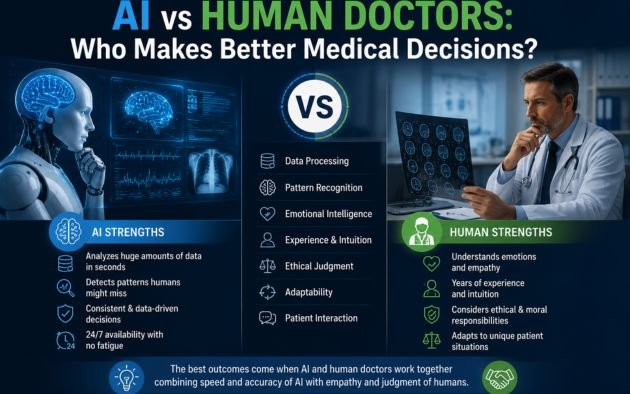
Strengths of AI in Healthcare
AI offers several important advantages in medical decision-making.
1. Faster Data Analysis
AI systems can process enormous amounts of medical information within seconds.
AI can analyze:
- Thousands of patient records
- Medical scans
- Clinical studies
- Research databases
much faster than humans.
This speed becomes especially valuable during emergencies.
2. Improved Pattern Detection
AI is highly effective at identifying hidden patterns in healthcare data.
AI systems can detect:
- Early cancer signs
- Heart abnormalities
- Brain disorders
- Disease risks
that may sometimes be difficult for humans to notice.
3. Reduced Human Errors
Fatigue, stress, and workload can sometimes affect human medical decisions.
AI systems help reduce diagnostic errors by continuously analyzing data with consistent accuracy.
4. Continuous Monitoring
AI-powered systems can monitor patients 24/7.
Hospitals use AI to track:
- Heart rate
- Oxygen levels
- Blood pressure
- Breathing patterns
AI can alert doctors immediately if it detects dangerous changes.
➡ Related Article:
How AI Is Helping Doctors During Emergency Situations
5. Access to Massive Medical Knowledge
AI systems can instantly access large medical databases and research studies.
This helps doctors stay informed about:
- Treatment guidelines
- Drug interactions
- Research findings
- Clinical recommendations
AI supports evidence-based medical decision-making.
Strengths of Human Doctors
Despite rapid AI advancement, human doctors still provide critical qualities that machines cannot fully replace.
1. Emotional Understanding and Empathy
Healthcare is deeply human.
Patients often need:
- Emotional support
- Reassurance
- Compassion
- Trust
Human doctors understand emotions and communicate with empathy during difficult situations.
AI cannot truly understand human feelings or emotional suffering.
2. Ethical and Moral Judgment
Medical decisions sometimes involve complex ethical situations.
Doctors may need to consider:
- Patient wishes
- Family concerns
- Cultural values
- Ethical responsibilities
Human judgment is essential in these situations.
AI lacks moral understanding and ethical reasoning.
3. Clinical Experience and Intuition
Experienced doctors develop intuition through years of patient care.
They can recognize subtle signs and unusual situations that may not exist in AI training data.
Human intuition remains extremely valuable in complex medical cases.
4. Communication Skills
Doctors communicate with patients, families, nurses, and healthcare teams.
Good communication helps:
- Build trust
- Explain treatments
- Reduce anxiety
- Improve patient cooperation
AI-generated communication still lacks a natural human connection.
5. Adaptability in Unpredictable Situations
Human doctors can adapt quickly during unexpected medical situations.
AI systems depend heavily on training data and may struggle with unfamiliar or highly unusual cases.
Can AI Diagnose Diseases Better Than Doctors?
In some specialized areas, AI systems have shown impressive performance.
AI can assist in:
- Cancer detection
- Medical imaging analysis
- Radiology
- Pattern recognition
Some AI imaging systems can detect abnormalities with very high accuracy.
However, AI still has limitations:
- It depends on data quality.
- It may generate incorrect predictions.
- It lacks human context understanding.
Most experts believe the best results come when AI supports doctors rather than replacing them.
Risks of Depending Too Much on AI
Although AI offers many advantages, overdependence on AI can create serious problems.
Incorrect AI Predictions
AI systems can sometimes generate inaccurate recommendations.
This is especially dangerous in healthcare, where mistakes can affect patient safety.
AI Bias
If AI is trained on incomplete or biased data, it may produce unfair or inaccurate outcomes.
This can affect diagnosis quality and treatment recommendations.
Data Privacy Concerns
Healthcare AI systems require large amounts of patient data.
Protecting sensitive medical information is extremely important.
Reduced Human Interaction
Patients often prefer human communication during medical care.
Over-automation may reduce the personal connection between patients and healthcare professionals.
Future of AI and Human Doctors Working Together
The future of healthcare will likely involve collaboration between AI systems and healthcare professionals.
AI may continue helping doctors by:
- Analyzing data faster
- Monitoring patients
- Supporting diagnosis
- Automating documentation
- Improving workflow efficiency
Meanwhile, doctors will continue providing:
- Human care
- Emotional support
- Ethical decision-making
- Clinical judgment
This partnership may create smarter and more efficient healthcare systems.
➡ Related Article:
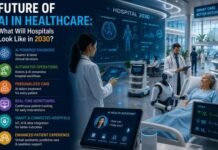
Future of AI in Healthcare: What Will Hospitals Look Like in 2030?
AI Will Assist Doctors, Not Replace Them
Most healthcare experts believe AI is more likely to assist doctors rather than fully replace them.
AI works best as:
- A support system
- A decision-making assistant
- A data analysis tool
Doctors remain essential because healthcare involves more than just technology.
Patients still need human understanding, trust, and compassionate care.
Challenges Healthcare Systems Must Solve
To use AI safely and effectively, healthcare systems must address several important challenges.
Training Healthcare Professionals
Doctors and medical staff need proper AI training.
Strong AI Regulations
Governments and healthcare organizations must create clear regulations for medical AI systems.
Ethical AI Development
Healthcare AI systems should remain transparent, safe, and fair.
Balancing Technology and Human Care
Healthcare systems must ensure that AI enhances healthcare rather than reducing human connection.
Final Thoughts
The debate between AI and human doctors is not about choosing one over the other. Both have unique strengths that can improve healthcare when combined effectively.
AI offers:
- Speed
- Data analysis
- Pattern recognition
- Continuous monitoring
Human doctors provide:
- Empathy
- Ethical judgment
- Clinical intuition
- Emotional understanding
The future of medicine will likely involve collaboration between intelligent AI systems and experienced healthcare professionals working together to improve patient care and medical outcomes.
AI may transform healthcare dramatically, but human doctors will continue playing an essential role in medicine for many years to come.