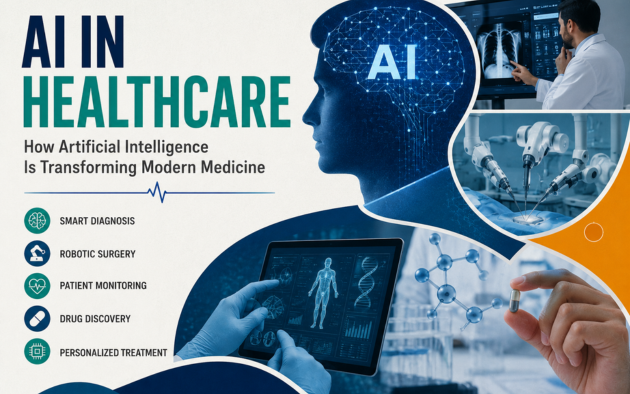
Artificial Intelligence (AI) is becoming one of the most revolutionary technologies in modern healthcare. From detecting life-threatening diseases to improving hospital management, AI in healthcare is changing how doctors diagnose, treat, and monitor patients.
Today, healthcare systems generate massive amounts of medical data every second. Managing this data manually is difficult and time-consuming. This is where artificial intelligence plays an important role in the medical industry. Artificial intelligence can analyze huge amounts of medical information quickly and accurately, helping healthcare professionals make smarter decisions.
AI is already being used in:
- Disease diagnosis
- Medical imaging
- Drug discovery
- Robotic surgery
- Personalized medicine
- Mental health support
- Remote patient monitoring
- Hospital automation
As healthcare technology continues to advance, experts believe that artificial intelligence may become one of the most important tools for improving global healthcare systems.
In this complete guide, we will explore:
- What AI in healthcare means
- How artificial intelligence works in medicine
- Real-world applications of this technology
- Benefits and risks
- AI medical tools
- Future trends
- Challenges and ethical concerns
- How AI may shape the future of medicine
What Is AI in Healthcare?
AI in healthcare refers to the use of computer systems, machine learning algorithms, and advanced technologies to perform healthcare tasks that usually require human intelligence.
Artificial intelligence systems can:
- Study medical data
- Identify patterns
- Predict diseases
- Assist doctors
- Improve treatment planning
- Automate healthcare operations
AI systems learn from data and continuously improve over time.
For example:
- AI can analyze X-rays to detect cancer.
- AI chatbots can answer patient questions.
- AI software can predict heart attack risks.
The main goal of AI healthcare technology is to improve patient care, increase medical accuracy, reduce errors, and save time.
Evolution of AI in Healthcare
The healthcare industry has changed significantly over the last few decades. Here’s what people have experienced:
Traditional Healthcare Challenges
Before AI:
- Diagnosis often took longer
- Human errors were more common
- Medical records were difficult to manage
- Healthcare systems were less efficient
Doctors had to manually study reports, scans, and patient histories.
Rise of Digital Healthcare
The introduction of:
- Electronic Health Records (EHRs)
- Cloud computing
- Big data
- Wearable devices
created huge amounts of medical information.
AI became necessary to process and analyze this healthcare data efficiently.
Modern AI Healthcare Era
Today, AI systems can:
- Detect diseases early
- Analyze millions of medical records
- Support robotic surgeries
- Monitor patients remotely
- Help researchers develop medicines faster
AI is now becoming a major part of modern medical technology.
How AI Works in Healthcare?
AI systems use multiple advanced technologies.
Machine Learning (ML)
Machine learning allows computers to learn from medical data without direct programming.
The system improves accuracy over time by studying patterns.
Example:
AI can learn how cancer appears in medical scans after analyzing thousands of images.
Deep Learning
Deep learning is a more advanced form of machine learning.
It uses neural networks that imitate the human brain.
Deep learning helps AI:
- Detect tumors
- Analyze MRI scans
- Recognize disease patterns
Natural Language Processing (NLP)
NLP allows AI to understand human language.
In healthcare, NLP helps analyze:
- Doctor notes
- Medical reports
- Patient conversations
This improves healthcare documentation and data management.
Computer Vision
Computer vision helps AI interpret medical images.
It is widely used in:
- Radiology
- Eye care
- Pathology
- Cancer detection
Predictive Analytics
Predictive AI analyzes patient data to predict future health risks.
Hospitals use predictive analytics to:
- Identify high-risk patients
- Prevent complications
- Improve treatment planning
Major Applications of AI in Healthcare
1. AI for Disease Diagnosis
AI-powered diagnosis is one of the fastest-growing areas in healthcare.
AI can analyze:
- X-rays
- CT scans
- MRI scans
- Blood reports
- Lab results
much faster than humans.
Diseases AI Can Detect
AI is being used for:
- Cancer detection
- Diabetes prediction
- Heart disease analysis
- Stroke risk detection
- Neurological disorders
- Eye disease screening
Early diagnosis improves treatment success rates and may save lives.
2. AI in Medical Imaging
Medical imaging is one of the most important uses of artificial intelligence.
AI helps radiologists:
- Detect abnormalities
- Improve image accuracy
- Reduce diagnostic mistakes
- Speed up report generation
AI imaging tools are widely used in:
- Cancer screening
- Brain scans
- Lung disease detection
- Eye disease diagnosis
3. AI in Drug Discovery
Traditional drug development can take more than 10 years.
AI helps pharmaceutical companies:
- Analyze chemical compounds
- Identify drug candidates
- Predict treatment success
- Reduce research time
AI became highly important during the development of treatments and vaccines for infectious diseases.
4. AI-Powered Robotic Surgery
AI-assisted robotic systems help surgeons perform complex operations more precisely.
Benefits of Robotic Surgery
- Smaller incisions
- Faster recovery
- Reduced pain
- Lower blood loss
- Improved surgical precision
Robotic surgery is increasingly used in:
- Heart surgery
- Orthopedic surgery
- Urology
- Gynecology
5. AI in Personalized Medicine
Every patient responds differently to treatment.
AI helps doctors create personalized healthcare plans using:
- Genetics
- Lifestyle
- Medical history
- Biomarker data
This is known as precision medicine.
Personalized medicine improves treatment effectiveness and reduces side effects.
6. AI in Mental Health
Artificial intelligence (AI) is also transforming mental healthcare.
AI mental health tools can:
- Monitor emotional patterns
- Detect depression signs
- Support therapy sessions
- Provide mental wellness guidance
Some AI chatbots now offer basic emotional support and mental health screening.
7. AI in Remote Patient Monitoring
Wearable devices and smart healthcare systems use AI to monitor patients remotely.
These tools track:
- Heart rate
- Blood pressure
- Oxygen levels
- Sleep patterns
- Blood sugar levels
Doctors can monitor patients in real time without hospital visits.
8. AI Virtual Assistants and Chatbots
AI assistants improve patient communication.
They help:
- Schedule appointments
- Send medication reminders
- Answer common medical questions
- Provide symptom guidance
This reduces hospital workload and improves patient convenience.
9. AI in Hospital Management
Hospitals use AI to improve operational efficiency.
AI helps manage:
- Patient records
- Staff scheduling
- Resource allocation
- Billing systems
- Emergency response systems
This helps hospitals save time and reduce costs.
Benefits of AI in Healthcare
Faster Diagnosis
AI can analyze medical data within seconds.
This allows doctors to diagnose diseases earlier.
Improved Accuracy
AI reduces the risk of human error and improves diagnostic precision.
Better Patient Care
AI supports personalized treatment plans and continuous patient monitoring.
Reduced Healthcare Costs
Automation helps hospitals improve efficiency and reduce operational expenses.
24/7 Medical Support
AI healthcare systems provide support anytime through apps and chatbots.
Improved Research and Innovation
AI accelerates medical research and scientific discoveries.
Challenges and Risks of AI in Healthcare
Although AI offers many advantages, some challenges require attention.
1. Data Privacy and Security
Healthcare data is highly sensitive.
Protecting patient information is a major concern.
Cybersecurity risks remain a challenge for AI healthcare systems.
2. High Costs
Advanced AI technologies can be expensive for hospitals and clinics.
3. Ethical Concerns
Important ethical questions include:
- AI decision transparency
- Responsibility for medical errors
- Bias in AI systems
Human supervision remains essential.
4. Dependence on Data Quality
AI systems are only as good as the data used for training.
Poor-quality data may lead to inaccurate predictions.
5. Limited Human Understanding
AI lacks human emotions, empathy, and emotional intelligence.
Doctors still play a critical role in patient care.
AI in Healthcare Examples
Many healthcare organizations already use AI technologies.
Real-World Examples
- AI-powered cancer detection software
- Smart wearable fitness trackers
- AI heart monitoring systems
- Robotic surgical systems
- Virtual healthcare assistants
- AI symptom checker apps
The healthcare industry continues investing billions into AI innovation.
Future of AI in Healthcare
The future of artificial intelligence in healthcare looks extremely promising.
Experts believe AI may soon help with:
- Predicting diseases before symptoms appear
- Personalized preventive healthcare
- AI-powered hospitals
- Smart health monitoring
- Advanced robotic surgeries
- Faster drug discovery
- AI-powered medical research
Future healthcare may become more personalized, data-driven, and preventive.
Will AI Replace Doctors?
AI is unlikely to fully replace doctors.
Instead, AI works best as a support tool for healthcare professionals.
Doctors provide:
- Human judgment
- Emotional understanding
- Ethical decision-making
- Patient communication
The combination of AI and human expertise may create the best healthcare outcomes.
How AI Is Improving Patient Experience?
Patients are already benefiting from AI-driven healthcare systems.
AI improves:
- Appointment scheduling
- Faster diagnosis
- Shorter waiting times
- Personalized treatments
- Remote healthcare access
This creates a more convenient healthcare experience.
AI and the Future of Global Healthcare
AI has the potential to improve healthcare access worldwide.
In developing regions, AI may help:
- Reduce doctor shortages
- Improve rural healthcare
- Support telemedicine
- Provide faster disease screening
AI could make healthcare more affordable and accessible for millions of people.
Final Thoughts
Artificial Intelligence is transforming nearly every area of modern medicine. From disease diagnosis to robotic surgeries and personalized treatments, AI in healthcare is improving medical efficiency, accuracy, and patient outcomes.
Although challenges such as privacy, ethics, and implementation costs still exist, the future of AI healthcare technology appears highly promising.
As technology continues evolving, AI may become one of the most powerful tools in the future of global healthcare and medical innovation.
Understanding AI’s role in healthcare is important because it is shaping the next generation of medicine, patient care, and scientific discovery.