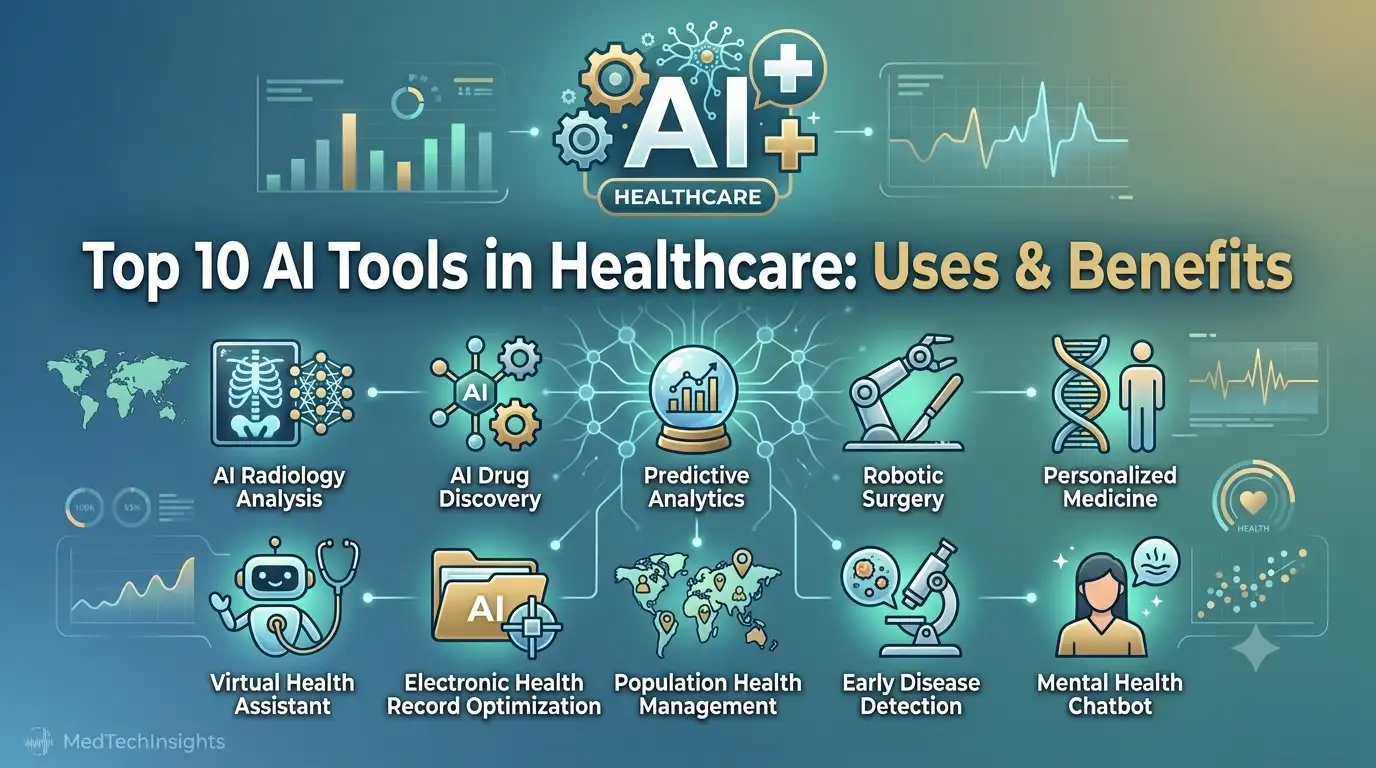
Artificial intelligence is changing how healthcare professionals analyze medical information, document consultations, detect potential diseases, and coordinate patient care. From AI-assisted medical imaging to automated clinical notes and precision medicine, healthcare organizations are exploring tools that can improve efficiency while supporting better-informed clinical decisions.
However, every healthcare AI tool is built for a different purpose. Some are designed for radiologists, others help oncologists interpret complex data, and some reduce the administrative work associated with patient consultations and hospital management.
In this guide, we will explore 10 notable AI tools in healthcare, their primary applications, key features, and practical limitations. We also explain how hospitals, clinics, researchers, and healthcare technology teams can evaluate these solutions before adopting them.
Important: AI tools support healthcare workflows but do not automatically replace professional medical judgment. Their capabilities, regulatory status, and availability vary by product, country, and intended use.
What Are AI Tools in Healthcare?
AI tools in healthcare are software applications that use technologies such as machine learning, natural language processing, computer vision, and generative AI to analyze medical information or assist with healthcare-related tasks.
Depending on their intended purpose, these tools can help clinicians review medical images, summarize patient records, identify patterns in clinical data, prepare documentation, coordinate urgent care, or accelerate biomedical research.
For example, an AI imaging system may flag a scan that requires urgent review, while an AI medical scribe may convert a patient consultation into a draft clinical note for a doctor to check.
The main objective is to support healthcare professionals with relevant information, reduce repetitive work, and improve the consistency of selected processes.
Why Are AI Tools Becoming Important in Healthcare?
Healthcare providers manage large volumes of information while balancing clinical responsibilities, patient expectations, staffing requirements, and operational costs. AI can help address some of these pressures when implemented appropriately.
Key applications include:
- Diagnostic support: Identifying suspicious patterns in radiology images, pathology slides, and other clinical data.
- Clinical documentation: Preparing draft notes, summaries, and other medical records.
- Patient risk assessment: Helping care teams identify patients who may need additional monitoring.
- Precision medicine: Supporting the analysis of genomic and clinical information.
- Hospital operations: Improving patient flow, scheduling, and resource planning.
- Medical research: Helping researchers analyze datasets and investigate potential drug candidates.
The effectiveness of any application depends on the quality of the underlying data, clinical validation, integration with existing systems, and appropriate human oversight.
Top 10 AI Tools in Healthcare
The following tools represent different areas of healthcare AI. This is a practical, use-case-based selection rather than a definitive ranking of clinical performance. The most suitable option depends on an organization’s needs, location, budget, and technical requirements.
1. Aidoc — AI-Powered Medical Imaging
Best for: Radiology departments and hospital imaging workflows.
Aidoc develops AI solutions that assist healthcare professionals in analyzing medical imaging and prioritizing cases that may require prompt attention.
Its technology can help flag suspected abnormalities in supported imaging studies and notify relevant clinical teams. This can be particularly useful in busy radiology departments, where prioritizing time-sensitive findings is important.
Key applications:
- AI-assisted analysis of supported CT and other imaging studies.
- Identification and prioritization of potentially urgent findings.
- Workflow coordination between radiologists and clinical teams.
- Integration with relevant hospital imaging systems.
Main benefit: Helps imaging teams direct attention toward potentially critical cases.
Limitation: Performance depends on the specific algorithm, supported examination, image quality, and clinical setting. AI-generated alerts still require appropriate review and follow-up.
2. Viz.ai — AI for Stroke Detection and Care Coordination
Best for: Stroke centers, emergency departments, and multidisciplinary hospital teams.
Viz.ai focuses on AI-assisted disease detection and care coordination. Its solutions are designed to help clinical teams identify potentially time-sensitive conditions and communicate relevant findings more efficiently.
In stroke care, delays between imaging, specialist notification, and treatment decisions can affect patient outcomes. AI-supported alerts and communication workflows may help reduce avoidable coordination delays.
Key applications:
- Detection support for selected acute conditions.
- Alerts for relevant clinical teams.
- Sharing imaging-related information.
- Coordination between emergency physicians and specialists.
Main benefit: Supports faster communication when multiple specialists need to respond to a potentially urgent case.
Limitation: The value of the system depends on clinical workflows, connectivity, and how promptly teams respond to alerts. It does not independently determine the appropriate treatment for every patient.
3. Tempus AI — Precision Medicine and Oncology
Best for: Oncology teams, precision medicine programs, and clinical researchers.
Tempus AI combines clinical and molecular data to support precision medicine and biomedical research. Its oncology-related services can help healthcare professionals understand relevant genomic findings and explore potential treatment options.
Cancer treatment decisions may involve tumor characteristics, molecular test results, patient history, and other clinical factors. AI and advanced data analytics can help organize and interpret these different information sources.
Key applications:
- Genomic profiling and molecular data analysis.
- Clinical data analysis for oncology.
- Support for identifying relevant clinical trials.
- Research into biomarkers and treatment responses.
Main benefit: Helps connect complex molecular information with clinically relevant research and treatment considerations.
Limitation: A genomic finding does not automatically establish that a particular treatment will work. Results must be interpreted alongside clinical evidence, patient circumstances, and applicable treatment guidelines.
4. PathAI — AI-Assisted Digital Pathology
Best for: Pathology laboratories, diagnostic organizations, and pharmaceutical researchers.
PathAI develops AI technologies for pathology, including the analysis of digitized tissue images. These systems can assist with identifying patterns in tissue samples and quantifying features relevant to research or diagnostic workflows.
Digital pathology is especially valuable when laboratories need to analyze large volumes of tissue data, standardize measurements, or support research involving disease characteristics.
Key applications:
- Analysis of digitized pathology images.
- Quantification of tissue and cellular features.
- Support for cancer-related research.
- Biomarker analysis and pharmaceutical research.
Main benefit: Helps pathologists and researchers analyze complex tissue data more systematically.
Limitation: Supported tasks and permitted clinical uses vary by product. AI findings should be interpreted within validated laboratory workflows and the relevant regulatory framework.
5. Microsoft Dragon Copilot — Clinical Documentation
Best for: Physicians and healthcare organizations seeking to reduce documentation workload.
Microsoft’s clinical AI offerings include Dragon Copilot, which brings together clinical documentation and workflow assistance capabilities. Depending on the configuration, such tools can help capture clinical conversations, generate draft notes, and support access to relevant information.
Clinical documentation is a promising area for AI because physicians often spend considerable time preparing records after patient consultations.
Key applications:
- Drafting clinical notes from consultations.
- Summarizing relevant encounter information.
- Supporting clinical documentation workflows.
- Reducing repetitive administrative tasks.
Main benefit: Can help clinicians spend less time composing routine documentation and more time engaging with patients.
Limitation: Generated notes may omit details, misinterpret terminology, or introduce inaccuracies. Clinicians must review and correct documentation before finalizing it in the medical record.
6. Google Cloud Vertex AI — Healthcare Data and AI Development
Best for: Healthcare technology teams, research organizations, and health systems developing custom AI applications.
Google Cloud Vertex AI is a platform for building, deploying, and managing AI applications. It is not a single ready-made medical diagnostic tool. Instead, it provides infrastructure and models that organizations can use to develop applications for appropriate healthcare workflows.
Potential uses include searching approved medical documents, summarizing information, analyzing datasets, and building applications that connect with healthcare information systems.
Key applications:
- Development of healthcare AI applications.
- Processing and searching relevant documents.
- Data analysis and model deployment.
- Integration with selected cloud-based workflows.
Main benefit: Offers flexibility to organizations building tailored AI solutions.
Limitation: Healthcare teams must establish suitable data governance, security controls, clinical validation, and regulatory compliance. Using a general AI platform does not automatically make an application clinically safe or approved for medical use.
7. Butterfly Network — AI-Assisted Portable Ultrasound
Best for: Clinicians using point-of-care ultrasound in hospitals, clinics, and resource-limited settings.
Butterfly Network develops portable ultrasound technology and associated software. Its handheld imaging devices can support examinations at the bedside, while selected software features may help users acquire or interpret ultrasound images.
Portable ultrasound can be useful when clinicians need imaging without transporting patients to a conventional imaging department.
Key applications:
- Point-of-care ultrasound examinations.
- Bedside assessment in appropriate clinical settings.
- Image acquisition and review.
- Ultrasound education and workflow support.
Main benefit: Makes ultrasound imaging more portable and potentially more accessible.
Limitation: The quality of the examination depends on the device, the clinical question, image acquisition, and the user’s training. Portable ultrasound does not replace every conventional imaging modality or specialist examination.
8. Insilico Medicine — AI for Drug Discovery
Best for: Pharmaceutical companies, biotechnology firms, and biomedical research teams.
Insilico Medicine uses AI in drug discovery and development research. AI systems can help researchers explore biological targets, identify promising molecular compounds, and prioritize candidates for further investigation.
Traditional drug development involves lengthy research, laboratory experiments, and clinical studies. AI may help narrow the range of candidates that researchers investigate, although it cannot eliminate the need for experimental testing.
Key applications:
- Identification of potential drug targets.
- Design and screening of candidate molecules.
- Analysis of biological datasets.
- Support for drug development research.
Main benefit: Helps researchers explore possibilities and prioritize experiments more efficiently.
Limitation: A molecule predicted to have promising properties is not necessarily safe or effective in humans. Laboratory studies, clinical trials, and regulatory review remain essential.
9. Qventus — AI for Hospital Operations
Best for: Hospital administrators, operational leaders, and large healthcare systems.
Qventus focuses on AI-supported hospital operations and workflow improvement. Its solutions are designed to help organizations address challenges involving patient flow, discharge planning, surgical scheduling, and operational coordination.
These applications are different from diagnostic AI: their primary purpose is to improve how healthcare services are organized and delivered.
Key applications:
- Patient flow and capacity management.
- Discharge planning support.
- Surgical and operational scheduling.
- Identification of workflow bottlenecks.
Main benefit: Helps hospital teams identify operational delays and coordinate resources more effectively.
Limitation: Results depend on reliable operational data, staff adoption, and changes to existing processes. AI recommendations alone cannot resolve shortages of beds, personnel, or other essential resources.
10. IBM Watson Health’s Successor Ecosystem — Healthcare Data Analytics
Best for: Organizations researching clinical data analytics and real-world healthcare evidence.
IBM Watson Health is a historical name that should not be treated as one current, unified product. IBM’s former healthcare data and analytics business was sold to Francisco Partners in 2022 and became part of Merative.
Organizations interested in this category should evaluate current products individually rather than assuming that all former Watson Health capabilities remain available under the same name.
Healthcare analytics platforms can help organizations study treatment patterns, evaluate healthcare costs, examine patient populations, and derive insights from large datasets.
Key applications:
- Real-world healthcare data analysis.
- Population health research.
- Treatment and outcomes research.
- Healthcare cost and utilization analysis.
Main benefit: Supports research and operational decisions using large-scale healthcare data.
Limitation: Analytical findings depend on data completeness, representativeness, and study design. Associations found in datasets do not necessarily prove that one treatment caused a particular outcome.
Comparison of the Top AI Tools in Healthcare
| AI Tool | Primary Use | Best Suited For |
| Aidoc | Imaging analysis and prioritization | Radiology departments |
| Viz.ai | Urgent-condition alerts and coordination | Emergency and stroke teams |
| Tempus AI | Genomic data and precision medicine | Oncology and research |
| PathAI | Digital pathology | Laboratories and researchers |
| Microsoft Dragon Copilot | Clinical documentation | Physicians and hospitals |
| Google Cloud Vertex AI | Custom AI application development | Healthcare technology teams |
| Butterfly Network | Portable ultrasound | Bedside imaging and clinical assessment |
| Insilico Medicine | AI-assisted drug discovery | Pharmaceutical research |
| Qventus | Hospital workflow optimization | Hospital administrators |
| Merative’s relevant analytics offerings | Healthcare data analysis | Health systems and researchers |
Benefits of AI Tools in Healthcare
More Efficient Clinical Workflows
AI can help summarize information, prepare draft documentation, organize data, and prioritize selected tasks. These capabilities may reduce repetitive work and help healthcare teams manage their time more effectively.
Support for Earlier Detection
Validated AI systems can flag patterns associated with certain diseases or abnormalities. When appropriately integrated into clinical workflows, this may help clinicians identify cases requiring further investigation.
AI alerts are not equivalent to confirmed diagnoses, and their benefits depend on how accurately and consistently the system performs in its intended setting.
More Personalized Research and Treatment Planning
AI can help researchers and clinicians examine molecular data, patient histories, and other relevant information. In precision medicine, these insights may contribute to discussions about treatment options, clinical trials, and further testing.
Better Operational Planning
Hospitals can use predictive analytics and workflow tools to examine patient flow, scheduling, and resource utilization. This can help managers identify inefficiencies and plan interventions.
Faster Biomedical Research
AI can help researchers analyze large datasets and prioritize potential drug candidates. It may improve the efficiency of selected research stages, although successful drug development still requires extensive testing.
Risks and Limitations of AI in Healthcare
AI adoption should involve more than comparing features or purchasing software. Healthcare organizations must evaluate patient safety, privacy, reliability, and accountability.
Data privacy and security
Medical records contain sensitive personal information. Organizations should examine access controls, encryption, data retention, vendor access, and whether patient information may be used to train external models.
Bias and unequal performance
A model may perform differently across patient populations, hospitals, or clinical settings. Evaluation should include the groups and circumstances in which the tool will actually be used.
Incorrect or misleading outputs
Generative AI can produce plausible-sounding but inaccurate information. Diagnostic systems can also generate false positives or miss relevant findings.
Integration challenges
A tool that does not work reliably with existing electronic health records, imaging systems, or staff workflows may create additional work rather than reduce it.
Regulatory requirements
Requirements depend on the intended use, jurisdiction, and whether the product qualifies as a regulated medical device or another type of healthcare software.
Human accountability
Healthcare professionals and organizations must establish clear responsibility for reviewing outputs, escalating concerns, and making clinical decisions.
How to Choose the Right AI Tool for a Healthcare Organization
Before selecting an AI healthcare solution, use the following checklist.
Define the problem: Identify whether the priority is documentation, imaging, patient communication, research, or hospital operations.
Verify the intended use: Confirm which clinical tasks the product supports and whether its claims match the organization’s needs.
Review clinical evidence: Ask for relevant validation studies, performance measures, known limitations, and evidence from settings comparable to yours.
Check privacy and security: Examine contractual protections, data storage, access permissions, retention policies, and applicable legal requirements.
Assess integration: Confirm compatibility with existing electronic health record (EHR), laboratory, imaging, and scheduling systems.
Run a controlled pilot: Establish baseline measures and evaluate performance, workflow impact, staff feedback, and potential safety issues.
Monitor after deployment: Track errors, alert quality, performance changes, and unintended consequences over time.
For example, a radiology department may prioritize sensitivity, specificity, and alert turnaround time. A hospital introducing an AI scribe may instead assess note accuracy, documentation time, and clinician satisfaction.
The right solution is the one that addresses a clearly defined problem with acceptable risks and measurable benefits—not necessarily the tool with the largest number of features.
Will AI Replace Doctors?
AI is more likely to change many healthcare tasks than eliminate the need for doctors.
AI can assist with pattern recognition, data analysis, documentation, and decision support. However, medical care also requires clinical reasoning, physical examination, communication, ethical judgment, and an understanding of individual patient circumstances.
Doctors must interpret AI-generated information alongside the patient’s symptoms, medical history, examination findings, and preferences. They also need to recognize when an AI recommendation is incomplete or inappropriate.
The most useful approach is to treat AI as a support technology within a properly supervised healthcare system, rather than as an independent substitute for medical professionals.
What Is the Future of AI in Healthcare?
Future AI developments may include more capable clinical documentation assistants, better integration of imaging and patient records, increasingly personalized medical research, and improved hospital operations.
Multimodal AI systems may help process different forms of information together, including text, images, laboratory results, and genomic data. However, broader capabilities will also increase the importance of independent validation, transparent limitations, and robust privacy safeguards.
Healthcare organizations are likely to place greater emphasis on measurable outcomes, interoperability, regulatory compliance, and responsible deployment rather than adopting AI simply because it is new.
Frequently Asked Questions
What are the best AI tools in healthcare?
Popular options include Aidoc for medical imaging, Viz.ai for care coordination, Tempus AI for precision medicine, PathAI for digital pathology, and Dragon Copilot for clinical documentation. The best choice depends on the specific healthcare task.
How is AI used in healthcare?
AI is used for medical imaging, clinical documentation, risk assessment, precision medicine, hospital operations, patient communication, and drug discovery. Its role varies according to the application and level of clinical validation.
Are AI tools in healthcare safe?
They can be useful when appropriately validated, monitored, and used within their intended scope. Safety depends on data quality, clinical oversight, privacy safeguards, and the consequences of incorrect outputs.
Can AI diagnose diseases?
Some regulated AI medical devices can assist with detecting or assessing specific conditions. Their capabilities are limited to defined intended uses, and AI results should be interpreted within appropriate clinical workflows.
Do hospitals need approval before using healthcare AI?
Requirements depend on the tool, intended use, jurisdiction, and whether it is regulated medical software. Hospitals should review applicable regulatory obligations, privacy laws, procurement requirements, and institutional policies before deployment.
What to consider before adopting AI?
Healthcare organizations should evaluate clinical evidence, intended use, data privacy, security, interoperability, cost, staff training, and measurable outcomes. A thorough evaluation can help identify risks before wider implementation.