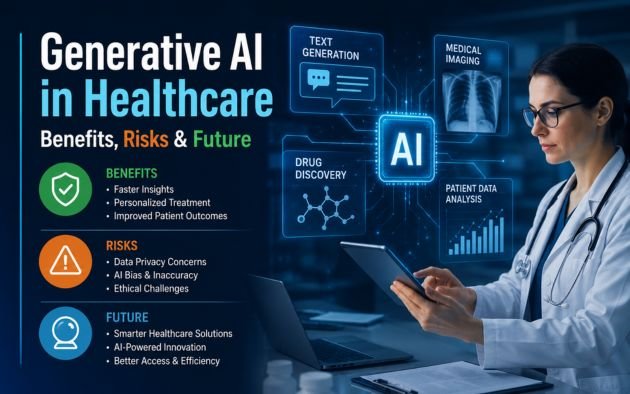
Artificial Intelligence is rapidly changing the healthcare industry, but one of the biggest technological breakthroughs in recent years is the rise of Generative AI. From creating medical reports to supporting doctors with clinical documentation and improving patient communication, Generative AI is transforming how healthcare systems operate.
Healthcare organizations worldwide are exploring how Generative AI can improve efficiency, reduce workload, support diagnosis, and enhance patient care. At the same time, experts are also raising concerns about privacy, misinformation, ethical risks, and overdependence on AI-generated medical content.
As AI technologies continue to evolve, Generative AI is expected to become one of the most influential innovations in modern healthcare.
In this article, we will explore what Generative AI in healthcare is, how it works, its real-world applications, benefits, risks, future possibilities, and whether it can truly transform the future of medicine.
What Is Generative AI in Healthcare?
Generative AI refers to advanced artificial intelligence systems capable of creating new content, such as:
- Text
- Images
- Medical summaries
- Reports
- Recommendations
- Predictive insights
Unlike traditional AI systems that mainly analyze existing data, Generative AI can generate human-like responses and content based on patterns learned from large datasets.
In healthcare, it is used to:
- Create medical documentation
- Assist healthcare professionals
- Analyze patient information
- Support medical research
- Improve communication
- Automate administrative tasks
Popular Generative AI technologies include:
- Large Language Models (LLMs)
- AI chatbots
- AI medical assistants
- Generative imaging systems
➡ Related Guide:
Artificial Intelligence in Healthcare: Complete Guide to AI Applications, Benefits, Risks & Future
Why Generative AI Is Becoming Important in Healthcare?
Healthcare systems generate massive amounts of information daily, including:
- Patient records
- Clinical notes
- Medical reports
- Laboratory results
- Imaging data
- Research documents
Managing this information manually can be time-consuming and overwhelming for healthcare professionals.
It helps reduce this burden by automating repetitive tasks and improving efficiency.
Hospitals and healthcare providers are adopting Generative AI because it helps:
- Save time
- Improve workflow efficiency
- Reduce administrative workload
- Support clinical decision-making
- Improve patient engagement
- Enhance healthcare accessibility
As healthcare demands continue to grow, Generative AI is becoming an important support system for modern medicine.
How Generative AI Works in Healthcare?
Generative AI systems are trained using enormous amounts of medical and language data. These systems learn patterns from:
- Medical literature
- Clinical guidelines
- Patient interactions
- Healthcare databases
- Research publications
Once trained, AI models can:
- Generate responses
- Summarize medical records
- Create patient reports
- Assist with documentation
- Answer medical queries
Many Generative AI systems use Natural Language Processing (NLP) to understand and generate human-like language.
This allows healthcare professionals to interact with AI systems using simple conversational prompts.
Real-World Applications of Generative AI in Healthcare
Generative AI is already being used in several areas of the medical industry.
1. Medical Documentation Automation
Doctors spend a significant amount of time creating clinical notes and patient documentation.
This technology can:
- Create summaries
- Generate clinical notes
- Draft discharge reports
- Organize patient records
This reduces administrative workload and allows doctors to spend more time with patients.
2. AI-Powered Medical Chatbots
Healthcare chatbots powered by Generative AI can provide:
- Symptom guidance
- Appointment support
- Medication reminders
- Basic health information
These systems improve patient communication and provide support outside hospital hours.
3. Clinical Decision Support
It can assist doctors by analyzing patient information and suggesting possible diagnoses or treatment recommendations.
AI support systems help healthcare professionals:
- Analyze complex data
- Identify patterns
- Improve treatment planning
However, final decisions should always remain under human medical supervision.
4. Personalized Patient Communication
It can create personalized healthcare communication based on individual patient needs.
Hospitals use AI-generated communication for:
- Follow-up instructions
- Appointment reminders
- Treatment education
- Patient engagement
This improves the overall patient experience.
5. Medical Research Assistance
Medical researchers use Generative AI to:
- Summarize research papers
- Analyze scientific data
- Identify trends
- Support literature reviews
AI can help researchers process massive amounts of information much faster than manual analysis.
6. Drug Discovery and Development
Generative AI is helping pharmaceutical companies accelerate drug research by predicting:
- Drug interactions
- Molecular structures
- Treatment effectiveness
AI-driven research may significantly reduce the time required for developing new medicines.
Benefits of Generative AI in Healthcare
Generative AI offers several important advantages for healthcare systems and medical professionals.
1. Reduced Administrative Burden
Doctors often spend hours handling paperwork and documentation.
It automates repetitive tasks, helping healthcare professionals focus more on patient care.
2. Faster Access to Information
AI systems can quickly summarize complex medical information and provide useful insights.
This helps doctors make faster decisions during diagnosis and treatment.
3. Improved Healthcare Efficiency
Automation improves hospital workflows and reduces delays in communication and documentation.
This can increase overall healthcare productivity.
4. Better Patient Engagement
AI-powered communication systems improve patient interaction and accessibility.
Patients can receive healthcare guidance and support more conveniently.
5. Support for Medical Research
Generative AI accelerates data analysis and supports scientific discovery.
Researchers can analyze large medical datasets more efficiently.
6. Personalized Healthcare Experience
AI systems can create personalized recommendations and educational content for patients.
This helps improve patient understanding and treatment compliance.
Risks and Challenges of Generative AI in Healthcare
Although Generative AI has major potential, it also introduces serious concerns that healthcare systems must address carefully.
1. Incorrect or Misleading Information
These AI systems can sometimes generate inaccurate or misleading responses.
This is known as AI hallucination.
In healthcare, incorrect information can become dangerous if used without proper medical review.
2. Data Privacy Concerns
Healthcare data is extremely sensitive.
AI systems require access to patient information, raising concerns about:
- Data security
- Privacy protection
- Unauthorized access
Healthcare organizations must ensure strong cybersecurity measures.
3. Ethical and Legal Issues
Questions remain about:
- Responsibility for AI errors
- Medical accountability
- Transparency in AI decisions
- Patient consent
Healthcare regulations must evolve alongside AI technologies.
4. Bias in AI Systems
AI models may produce biased outcomes if trained on incomplete or unbalanced medical data.
This can affect diagnosis accuracy and treatment recommendations.
Ensuring fair and diverse training data is essential.
5. Overdependence on AI
Healthcare professionals should avoid becoming overly dependent on AI-generated recommendations.
Human medical judgment remains critical in patient care.
AI should support doctors, not replace them.
Generative AI vs Traditional AI in Healthcare
There is an important difference between traditional AI and Generative AI.
| Traditional AI | Generative AI |
| Analyzes existing data | Creates new content |
| Detects patterns | Generates responses |
| Predicts outcomes | Produces summaries and recommendations |
| Focused on analysis | Focused on creation and interaction |
Both technologies are important and often work together in modern healthcare systems.
Future of Generative AI in Healthcare
The future of Generative AI in healthcare looks extremely promising.
Experts believe AI may soon support:
- Smart hospitals
- AI-powered patient assistants
- Personalized treatment planning
- Advanced clinical documentation
- Real-time healthcare support
- Predictive healthcare systems
Future hospitals may use Generative AI to automate many administrative and communication tasks while helping doctors make faster decisions.
➡ Related Article:
Future of AI in Healthcare: What Will Hospitals Look Like in 2030?
Can Generative AI Replace Doctors?
Generative AI is highly effective at processing information and generating responses, but it cannot fully replace healthcare professionals.
Doctors provide:
- Clinical experience
- Emotional understanding
- Ethical judgment
- Human communication
- Critical decision-making
AI lacks human empathy and real-world medical intuition.
The future of healthcare will likely involve collaboration between Generative AI systems and healthcare professionals.
➡ Related Article:
AI vs Human Doctors: Who Makes Better Medical Decisions?
How Healthcare Organizations Can Use Generative AI Responsibly
Healthcare providers must implement AI carefully and responsibly.
Best practices include:
- Human supervision
- Data privacy protection
- AI transparency
- Medical validation
- Ethical AI policies
- Regular monitoring
Responsible implementation is essential for safe and effective AI-assisted healthcare.
Final Thoughts
Generative AI is becoming one of the most transformative technologies in modern healthcare. From automating medical documentation to supporting patient communication and accelerating medical research, AI is helping healthcare systems become more efficient and connected.
However, this technology also comes with important risks related to privacy, ethics, misinformation, and overdependence on technology.
The future of healthcare is unlikely to involve AI replacing doctors completely. Instead, the most successful healthcare systems will likely combine human expertise with AI-powered support tools to improve patient outcomes and healthcare efficiency.
As technology continues to evolve, Generative AI may play a major role in shaping smarter, faster, and more personalized healthcare systems around the world.