Over the last 4-5 years, Artificial Intelligence (AI) has significantly changed the healthcare industry, and experts believe the next decade could completely change how hospitals operate. Technologies that once seemed futuristic are already becoming part of modern healthcare systems. From AI-powered diagnosis and robotic surgery to smart patient monitoring and virtual healthcare assistants, hospitals are entering a new era of intelligent healthcare.
As medical technology continues to evolve, hospitals in 2030 may become smarter, faster, more automated, and more personalized than ever before. Healthcare systems around the world are investing heavily in AI to improve patient care, reduce costs, increase efficiency, and solve growing healthcare challenges.
Doctors and hospitals today face major issues such as:
- Staff shortages
- Rising patient demands
- Increasing healthcare costs
- Administrative burden
- Delayed diagnosis
AI is expected to play a major role in solving many of these problems over the coming years.
In this article, we will explore how AI may transform hospitals by 2030, what future healthcare systems could look like, the technologies driving these changes, and the opportunities and risks that may come with AI-powered healthcare.
What Is AI in Healthcare?
Artificial Intelligence in healthcare refers to advanced computer systems that can analyze medical data, learn patterns, automate tasks, and support healthcare professionals in making medical decisions.
AI technologies used in healthcare include:
- Machine Learning
- Deep Learning
- Computer Vision
- Predictive Analytics
- Natural Language Processing
- Generative AI
These technologies are already helping hospitals improve:
- Diagnosis accuracy
- Patient monitoring
- Medical imaging
- Administrative workflows
- Emergency care
- Personalized treatment
➡ Related Guide:
Artificial Intelligence in Healthcare: Complete Guide to AI Applications, Benefits, Risks & Future
Why Hospitals Are Adopting AI So Quickly?
Healthcare systems worldwide are under increasing pressure due to:
- Aging populations
- Chronic diseases
- Staff shortages
- Rising operational costs
Traditional healthcare systems often struggle to manage growing patient needs efficiently.
AI helps hospitals by:
- Automating repetitive tasks
- Reducing human errors
- Improving workflow efficiency
- Supporting faster diagnosis
- Enhancing patient care
This is why hospitals and healthcare companies are rapidly investing in AI technologies.
What Could Hospitals Look Like in 2030?
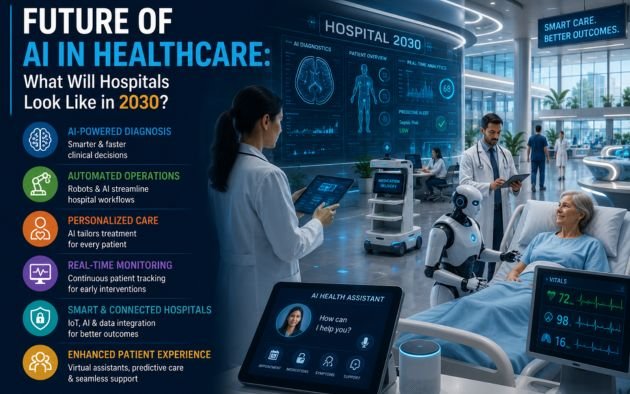
Hospitals in 2030 may operate very differently compared to today. AI is expected to become deeply integrated into almost every area of healthcare.
Future hospitals may become:
- Highly automated
- Data-driven
- Predictive
- Personalized
- Connected through smart systems
Let’s explore some of the major AI-powered changes expected in future hospitals.
1. AI-Powered Smart Hospitals
By 2030, many hospitals may function as fully connected smart healthcare systems.
AI-powered smart hospitals could use:
- Real-time monitoring
- Automated workflows
- Predictive analytics
- Intelligent patient management systems
AI may automatically track:
- Patient conditions
- Bed availability
- Staff scheduling
- Equipment usage
- Emergency risks
Smart hospitals could improve efficiency while reducing delays and operational costs.
2. Faster and More Accurate Diagnosis
AI-powered diagnostic systems are expected to become much more advanced by 2030.
Future AI systems may analyze:
- Medical scans
- Genetic information
- Patient history
- Laboratory reports
within seconds to help doctors diagnose diseases earlier and more accurately.
AI may improve the diagnosis of:
- Cancer
- Heart disease
- Neurological disorders
- Infectious diseases
Earlier diagnosis can improve survival rates and treatment success.
➡ Related Article:
Top 10 Real-World Applications of AI in Healthcare
3. Personalized Treatment Plans
One of the biggest future healthcare trends is personalized medicine.
AI systems may help doctors create treatment plans based on:
- Genetics
- Lifestyle
- Medical history
- Medication response
- Real-time health data
Instead of using the same treatment for every patient, hospitals may provide highly personalized care.
This could improve treatment effectiveness while reducing side effects.
4. AI-Powered Virtual Healthcare Assistants
Virtual healthcare assistants may become common in hospitals by 2030.
AI-powered assistants could:
- Answer patient questions
- Schedule appointments
- Provide medication reminders
- Explain treatment instructions
- Monitor recovery progress
These systems may improve communication and reduce hospital workload.
Some hospitals may even use AI assistants for multilingual patient support.
➡ Related Article:
Generative AI in Healthcare: Benefits, Risks & Future
5. Advanced Robotic Surgery
Robotic surgery is already growing rapidly, but future AI-powered surgical systems may become even more precise and intelligent.
Future robotic systems could:
- Assist surgeons in real time
- Reduce surgical complications
- Improve precision
- Shorten recovery time
AI-assisted robotic surgery may become standard for many complex procedures by 2030.
6. Real-Time Patient Monitoring
Future hospitals may use wearable AI devices and smart monitoring systems to track patient health continuously.
AI systems may monitor:
- Heart rate
- Oxygen levels
- Blood pressure
- Sleep patterns
- Glucose levels
These systems could alert doctors immediately if they detect severe abnormalities.
Continuous AI monitoring may improve patient safety significantly.
7. Predictive Healthcare and Disease Prevention
One of the most exciting future possibilities is predictive healthcare.
AI systems may identify disease risks before symptoms even appear.
Predictive AI may help prevent:
- Heart attacks
- Strokes
- Diabetes complications
- Respiratory failure
Future hospitals may focus more on prevention rather than only treating diseases after they develop.
8. AI in Emergency Healthcare
Emergency departments may become much faster and more efficient with AI support.
Future AI systems could:
- Predict emergency risks
- Optimize ambulance routes
- Prioritize critical patients
- Assist ICU monitoring
AI may help doctors respond faster during life-threatening situations.
➡ Related Article:
How AI Is Helping Doctors During Emergency Situations
9. Fully Digital and Paperless Hospitals
Many hospitals still struggle with paperwork and administrative burden.
By 2030, AI may automate:
- Medical records
- Billing systems
- Documentation
- Appointment scheduling
- Insurance processing
This could reduce administrative workload and allow healthcare professionals to focus more on patient care.
10. AI-Assisted Mental Healthcare
Mental healthcare may also benefit greatly from AI technologies.
Future AI systems may help:
- Monitor emotional health
- Detect early mental health risks
- Support therapy sessions
- Improve patient engagement
AI-powered mental healthcare tools could improve access to support services.
Benefits of AI-Powered Hospitals
AI-powered hospitals may offer several major advantages.
Faster Healthcare Services
Automation may reduce waiting times and improve hospital efficiency.
Better Diagnosis Accuracy
AI systems may help doctors detect diseases earlier and more accurately.
Improved Patient Safety
Continuous monitoring and predictive analytics may reduce medical complications.
Personalized Patient Care
AI may help hospitals provide customized treatment plans for individual patients.
Reduced Healthcare Costs
Automation and predictive systems may improve resource management and reduce unnecessary expenses.
Challenges and Risks of Future AI Hospitals
Although the future of AI in healthcare looks promising, there are also important risks and challenges.
Data Privacy Concerns
Future hospitals will rely heavily on patient data.
Protecting sensitive healthcare information will remain critical.
AI Bias and Inaccurate Predictions
AI systems depend on data quality.
Poor training data may produce biased or inaccurate healthcare outcomes.
Ethical Concerns
Questions may arise regarding:
- AI decision-making
- Medical accountability
- Human oversight
- Patient consent
High Technology Costs
Advanced AI healthcare systems may be expensive for smaller hospitals and developing regions.
Dependence on Technology
Healthcare systems must avoid becoming overly dependent on AI while maintaining human medical expertise.
Will AI Replace Doctors by 2030?
Many people fear that AI may replace doctors in the future, but most experts believe AI will mainly support healthcare professionals rather than replace them completely.
AI is highly effective at:
- Data analysis
- Monitoring
- Pattern recognition
- Automation
However, doctors still provide:
- Empathy
- Communication
- Ethical judgment
- Human understanding
- Clinical experience
The future of healthcare will likely involve collaboration between AI technologies and medical professionals.
➡ Related Article:
AI vs Human Doctors: Who Makes Better Medical Decisions?
The Role of Human Doctors in Future Hospitals
Even in highly automated hospitals, doctors will remain essential.
Healthcare involves more than technology. Patients still need:
- Human interaction
- Emotional reassurance
- Compassionate care
- Trust
AI may handle repetitive tasks, but doctors will continue making important medical decisions and providing patient-centered care.
Final Thoughts
Artificial Intelligence is expected to transform hospitals dramatically by 2030. Future healthcare systems may become smarter, faster, more connected, and more personalized than ever before.
AI-powered hospitals could improve diagnosis accuracy, automate administrative tasks, support emergency care, and enhance patient monitoring while helping healthcare professionals work more efficiently.
However, responsible implementation will remain extremely important. Healthcare systems must balance technological innovation with patient safety, ethical healthcare practices, privacy protection, and human medical expertise.
The future of healthcare is unlikely to be fully automated. Instead, the most successful hospitals may combine advanced AI technologies with skilled healthcare professionals to create smarter and more effective patient care systems.