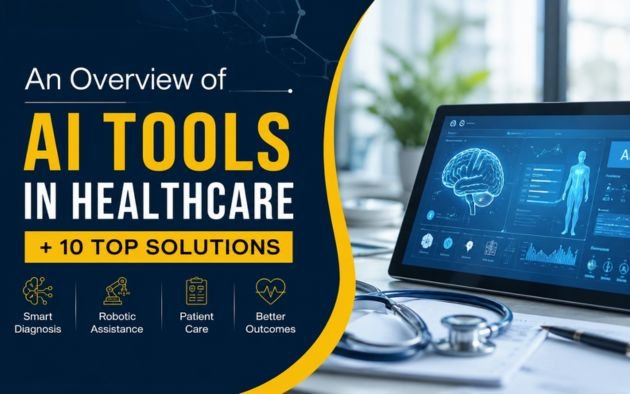
Artificial Intelligence is no longer a futuristic concept in healthcare. From helping doctors detect diseases earlier to improving hospital efficiency and patient care, AI tools are transforming the medical industry faster than many expected.
Today, hospitals, clinics, researchers, and even patients are using AI-powered healthcare solutions to make better medical decisions, reduce errors, and save time. Whether it’s AI-assisted diagnosis, robotic surgery, virtual health assistants, or predictive analytics, the healthcare sector is entering a completely new era.
In this guide, we’ll explore how AI tools are changing healthcare, their benefits and risks, and the top AI healthcare solutions currently shaping the future of medicine.
What Are AI Tools in Healthcare?
AI tools in healthcare are software systems powered by Artificial Intelligence technologies, such as:
- Machine Learning (ML)
- Natural Language Processing (NLP)
- Deep Learning
- Computer Vision
- Predictive Analytics
These tools analyze large amounts of medical data to help healthcare professionals make faster and more accurate decisions.
AI healthcare tools can:
- Detect diseases
- Analyze medical scans
- Predict patient risks
- Automate hospital workflows
- Assist in surgeries
- Improve patient communication
- Accelerate drug discovery
In simple terms, AI helps healthcare providers work smarter while improving patient outcomes.
Why AI Is Becoming Important in Healthcare?
Healthcare systems worldwide face several challenges:
- Shortage of medical staff
- Rising healthcare costs
- Increasing patient data
- Diagnostic errors
- Delayed treatments
- Administrative burden
AI tools help solve many of these issues by improving speed, efficiency, and accuracy.
According to industry reports, the global AI healthcare market is expected to grow rapidly over the next decade as hospitals increasingly adopt smart healthcare technologies.
How AI Tools Are Used in Healthcare?
AI applications are now used across almost every medical department.
1. Disease Diagnosis
AI algorithms can analyze:
- X-rays
- MRI scans
- CT scans
- Blood reports
- Eye scans
to detect diseases earlier than traditional methods in some cases.
AI is being used for:
- Cancer detection
- Heart disease prediction
- Eye disease screening
- Lung infection analysis
2. Virtual Health Assistants
AI-powered chatbots and assistants help patients:
- Book appointments
- Get symptom guidance
- Receive medication reminders
- Access health information
This reduces workload on healthcare staff and improves patient support.
3. Predictive Analytics
Hospitals use AI to predict:
- Patient deterioration
- ICU risks
- Readmission chances
- Disease outbreaks
Predictive healthcare analytics can help doctors take preventive action before conditions worsen.
4. Robotic Surgery
AI-assisted robotic systems allow surgeons to perform minimally invasive procedures with improved precision.
Benefits include:
- Smaller incisions
- Faster recovery
- Reduced blood loss
- Better surgical accuracy
5. Drug Discovery
AI tools can analyze massive datasets to identify potential drug compounds much faster than traditional research methods.
This technology became especially important during global health emergencies where faster vaccine and drug development was critical.
Benefits of AI Tools in Healthcare
Faster Diagnosis
AI systems can process medical images and patient data in seconds. This is how AI helps doctors identify problems more quickly.
Improved Accuracy
Some AI models can reduce human error in repetitive diagnostic tasks by detecting patterns that may be difficult to notice manually.
Better Patient Care
AI enables more personalized treatment plans based on patient history, genetics, and lifestyle data.
Reduced Administrative Work
Healthcare staff spend less time on paperwork and scheduling through automation tools.
Cost Efficiency
Hospitals can improve operational efficiency and reduce unnecessary expenses through predictive management systems.
Challenges and Risks of AI in Healthcare
While AI offers major benefits, it also comes with challenges.
Data Privacy Concerns
Healthcare data is highly sensitive. AI systems must follow strict privacy and security regulations.
Bias in AI Models
AI systems can sometimes produce biased results if trained on limited or unbalanced datasets.
Dependence on Technology
Overreliance on AI without human oversight may create risks in critical medical situations.
Regulatory and Ethical Issues
Healthcare AI tools require proper testing, transparency, and medical approval before large-scale use.
10 Top AI Healthcare Solutions Transforming Medicine
1. IBM Watson Health
IBM developed Watson Health to assist with medical data analysis, clinical decision support, and healthcare research.
Key features:
- Medical data analysis
- Clinical insights
- Oncology support
- Research assistance
2. Google DeepMind Health
Google DeepMind focuses on AI-driven healthcare research, including eye disease detection and medical imaging analysis.
Major areas:
- Eye scan analysis
- AI diagnostics
- Medical research
- Predictive healthcare systems
3. Aidoc
Aidoc helps radiologists analyze medical scans using AI-powered imaging solutions.
Benefits:
- Faster scan review
- Critical case prioritization
- Emergency detection support
4. Tempus
Tempus uses AI and data analytics to support personalized cancer treatment and precision medicine.
Main uses:
- Genomic analysis
- Cancer treatment support
- Clinical data insights
5. PathAI
PathAI improves pathology diagnostics using machine learning and image analysis.
Used for:
- Cancer pathology
- Tissue analysis
- Diagnostic accuracy improvement
6. Zebra Medical Vision
Zebra Medical Vision develops AI imaging tools for identifying diseases from medical scans.
Focus areas:
- Bone health
- Liver disease
- Cardiovascular conditions
7. Butterfly Network
Butterfly Network combines AI with portable ultrasound devices for faster bedside imaging.
Advantages:
- Portable diagnostics
- Faster imaging
- Point-of-care ultrasound
8. Viz.ai
Viz.ai helps doctors detect strokes and other critical conditions faster using AI algorithms.
Main benefits:
- Emergency alerts
- Faster stroke identification
- Improved coordination
9. Insilico Medicine
Insilico Medicine uses AI to accelerate drug discovery and pharmaceutical research.
Applications:
- Drug development
- Aging research
- Predictive biology
10. Babylon Health
Babylon Health provides AI-powered virtual healthcare consultations and symptom-checking tools.
Features:
- Virtual doctor consultations
- Symptom checker
- Digital healthcare access
Will AI Replace Doctors?
One of the biggest concerns surrounding healthcare AI is whether machines will replace doctors.
The reality is that AI is more likely to assist healthcare professionals rather than replace them completely.
Doctors provide:
- Human judgement
- Emotional understanding
- Ethical decision-making
- Complex clinical reasoning
AI works best as a support tool that enhances medical expertise instead of replacing it.
The Future of AI Tools in Healthcare
The future of healthcare AI looks highly promising.
Over the next decade, we may see:
- AI-powered hospitals
- Personalized medicine based on genetics
- Smart wearable health devices
- Real-time disease prediction
- AI-assisted remote surgeries
- Advanced robotic healthcare systems
As AI technology improves, healthcare may become faster, more affordable, and more accessible worldwide.
Final Thoughts
AI tools are rapidly changing the healthcare industry by improving diagnosis, patient care, hospital efficiency, and medical research.
From AI-powered imaging systems to predictive analytics and robotic surgery, healthcare organizations are increasingly adopting intelligent technologies to improve outcomes and reduce pressure on medical systems.
However, human expertise will remain essential. The best future for healthcare is likely a collaboration between skilled medical professionals and advanced AI technologies.
As the healthcare industry evolves, AI tools will continue to play a major role in shaping smarter and more efficient medical systems for the future.